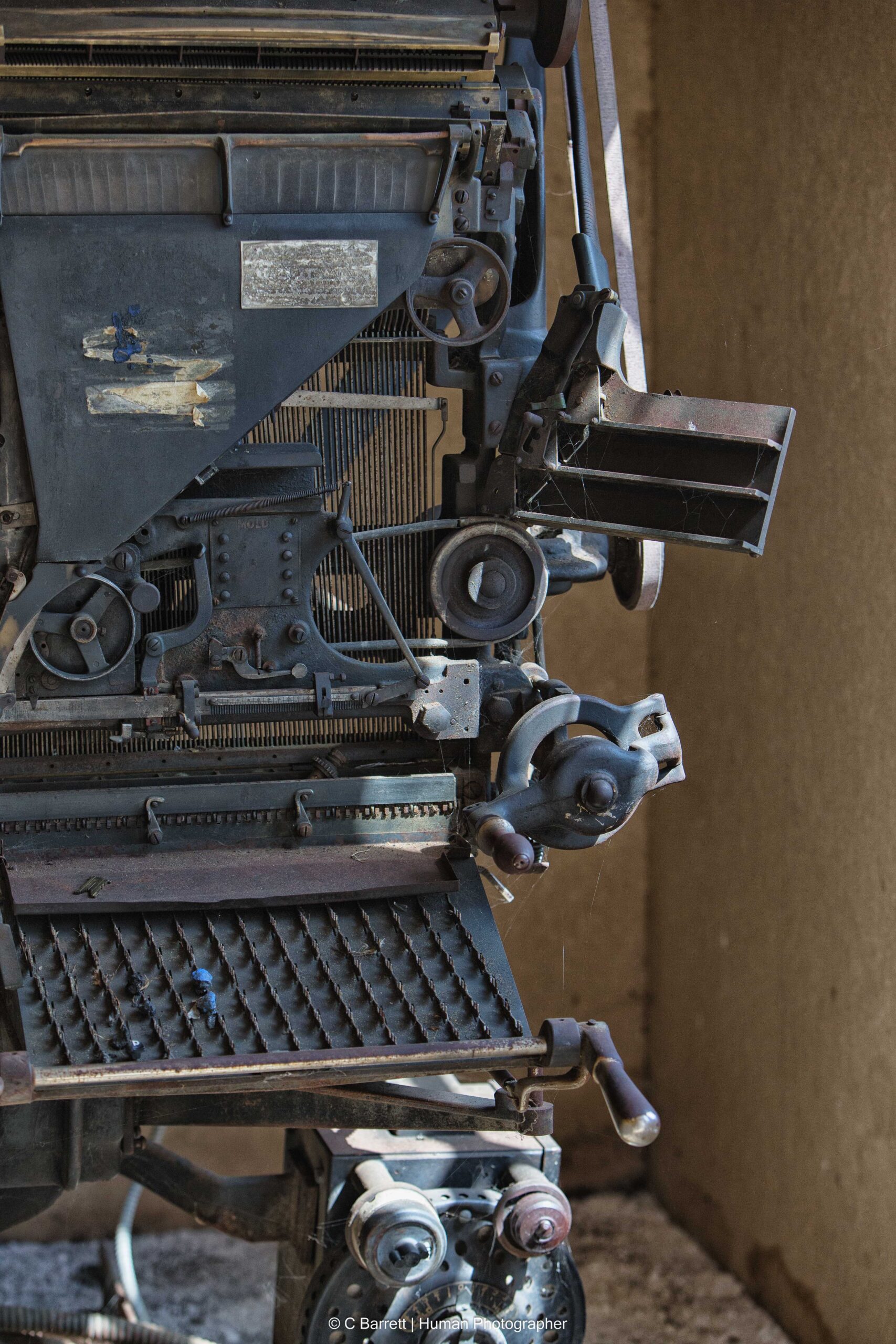
Rowley probably won’t remember us. As they no doubt hoped, we left no trace that we were there.
This road trip was winding down. We had no plans and no fixed destination for the day. We rolled generally northwards until I realized we may be getting dangerously close to civilization. At the first sign of nothingness we got off the main road and picked our way along dirt tracks and secondary highways, looking for some final treasures to fill our memory cards. I remembered that we were close to Rumsey: the badlands had one last thing to show us …`
Approaching the Tolman Bridge near Trochu reminds us that the geological forces that carved the badlands had also spent some time here. Yep, there was the Red Deer River winding its way through the valley. The epic strength of the river was perfectly concealed under the gentle blue-green skin. The valley stretched out as on both sides of the bridge revealing its scale. The road snaked up the other side, and as we climbed to level ground again all traces of the valley disappeared from view.
The road to Dry Island Buffalo Jump cuts across the shoulders of the landscape; determined farmers have scraped out pastures, and fields for very hearty crops. The parking lot for the viewpoint comes up suddenly, and a moment later we are gaping at a chasm in the earth, where plains hunters staged one of the most epic hunts in (semi) recorded history. Bison, then numbering in the millions, were a critical resource for Canada’s earliest residents. The more famous Head-Smashed-In Buffalo jump includes interactive displays and a centre devoted to exploring the history of the site. Here there are no such distractions. One can stand at the edge and imagine the terrible and amazing scene that would play out here.

Archaeologists have decoded some of the process: an elaborate track filled with chutes and diversions to channel bison towards the jump, a community-wide coordinated effort, and a stampede of gargantuan scale, would drive bison over the edge of these cliffs. Below, an encampment would harvest meat, skins, bone–the components of surviving life on the plains of Alberta. It would have been a deadly ballet played out at breakneck speed. Intense preparations were needed as this was no one-day affair. In fact, some evidence may indicate that such an event may occur once in a generation.
I love the Buffalo Jump. It’s as big a view as one can hope for in Alberta. It’s vastness is absolute. I have a 14mm lens that is almost useless anywhere. It needs a big room. This was a very big room indeed.
My Dad, however, was less thrilled. Of course, we all like to photograph different things and he is more likely to be poking around an old homestead than hiking up a mountain for a better view. To find relics here you would need a telescope. And probably an earth mover. Everything that lived here left long ago; anything that didn’t is buried under hundreds of feet of earth. Standing at the viewpoint is like looking into an endless sea of green, broken only by an infinite sea of blue. I plan to come back to this place soon, with a model. Something about the landform screams out ‘fine art in progress’. It’s not that he was not impressed by the magnificent view. But it was a hot day, and a long path that had brought us here. Energy was diminishing. After focusing on the small details, the slow-moving life in towns that mark time not in seasons. but in generations, the Buffalo Jump in a sense emphasized one last, important lesson from the road: We were tiny specks in a massive landscape. There is still so much left to see.

Near Bashaw, just north of a train track, where the road split a natural wetland in half, it seems we found a transit station for a virtual menagerie of birds. Hawks, an Osprey, more ducks than we could count, Geese, and a large flock of Pelicans, occupied various spots everywhere. It was no fluke location: special reflectors hung from all the phone and power lines nearby to reduce collisions. This was a natural resting place on a migratory path that ran from Northern Canada to South America. We spent an hour photographing birds. With more time and a few different pieces of equipment one could easily fill a journal with National Geographic grade images from this spot. In truth, such places are quite common, if you take the time to find them. I recalled the many times I had driven endlessly looking for such places, expecting them to be where I wanted them to be. Idiot. Next time I guess I will think more like a bird, or at least, look for the signs left by smart people who know.

Along the road to deciding where we would end the day there came a realization that the Bruce Hotel was a mere 90 minutes out of our way, and suddenly we were very hungry. It also locked in a final schedule for a trip that previously had none. The Bruce Hotel was about 90 minutes southeast of Edmonton on Hwy. 14. We called our people to warn them.
If you’ve never been to the Bruce Hotel, here’s a little gift for you: (780) 688-3922. Call them.
For all the right reasons, Deb and Karl decided that they would make a tiny old hotel in the middle of –well, nowhere really — into a steakhouse that rivals anything in the City of Edmonton (or Calgary, you arrogant beef eating know-it-alls). It’s not fancy–in fact we looked so rough I had to get my Dad to check my hair. And when he told me it was a mess, I had no choice but to let it slide. All in the name of good steak.
Vegetarians beware. There is no getting through this story without realizing that somewhere, a very well cared for cow was sacrificed to produce the amazing steaks that we devoured. Very few people can prepare a steak like Deb, ‘the steak doctor‘. The staff, friendly as always, the crowd, unassuming, down-to-earth, real people. Here we could figuratively put our feet up, hell, we, we could probably do it literally if we asked nicely enough. Like being home before getting home, the Bruce was the perfect place to depressurize from the road. A pair of 10 oz. steaks arrived, and everything went very quiet for a while.
It occurred to me that my wife would be quite jealous that I was enjoying supper at the Bruce. So of course, I had to taunt her. I sent a selfie with the room in the background.

She texts back,
“Is that your mad face” (No question mark. In the age of text punctuations is like, so over.)
I send this:

She writes,
“Looks good. What restaurant r u at”
In the end there was only one way to communicate where I was via image, so I asked our server to take my iPhone and snap a picture of Kerri.

My wife got it, finally. You’ll get it too if you go to the Bruce. And this has been a long-winded story, so you’ve have enough time to book a date already (I gave you the phone number).
Our chaotic route took us to Wainright and the mythical Wainright Dunes, through the Neutral Hills, Consort, Altario, Loverna, Esther, Oyen, Acadia Valley, Empress. We found a weird tower on the way Finnegan, Dorothy, and Drumheller. We never did find the real Nacmine (like, where the f#@k is Nacmine?) but we did find Horsethief Canyon, Rowley, the Rumsey Tolman Badlands Heritage Range, Dry Island Buffalo Jump, Buffalo Lake, (don’t go there), Bashaw, Bruce (supper), and finally, Edmonton. We saw a badger, a pronghorn, and a virtual freak show of strange birds. We didn’t see many people, but the ones we did were pretty special. Even you, Betty.
More than 1,300 kms on the odometer testified that it was never a straight line. But somewhere in the comfort of having no schedule, no destination, and no expectations beyond whatever is revealed around the next bend, there is a sense of clarity that cannot be defined by a plan; a calmness of being that, if only for a few days, lets you forget real life and become an explorer, a pioneer to a place of your own making.